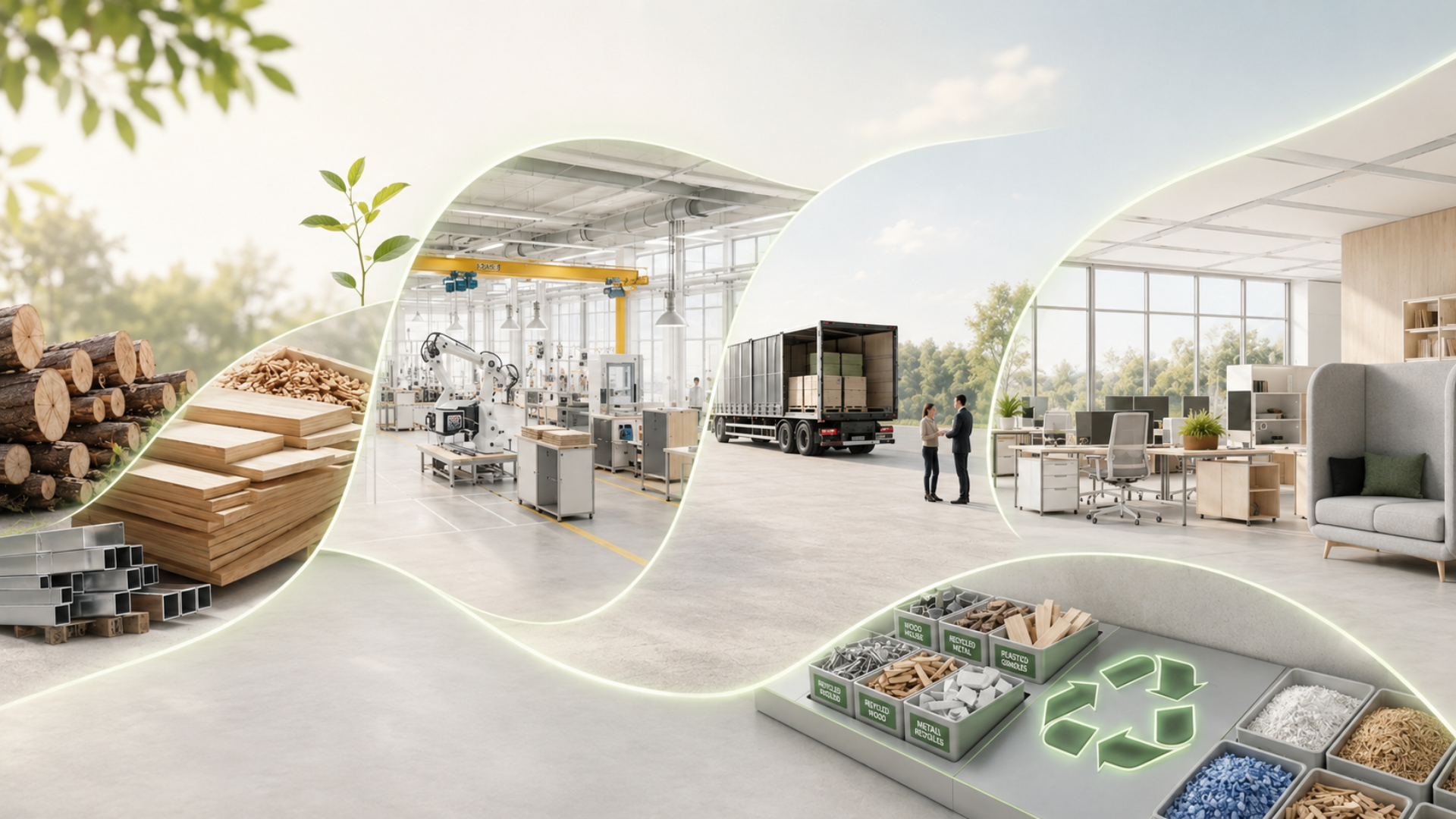
A sustainable value chain encompasses all activities, resources, and relationships associated with a product—from raw material sourcing, production, and distribution, through to use, reuse, or disposal. Under the ESG approach, the environmental, social, and business impact of this entire process is evaluated.
In an era of global crises, from pandemics to geopolitical conflicts, the business world has learned one crucial lesson: no company is an island. Today, success is no longer measured solely by financial results, but by the resilience and ethics of the entire ecosystem in which an enterprise operates.
Key takeaways:
- The value chain is a broad concept: It encompasses the full life cycle of a product – from raw material extraction (upstream), through production, to recycling or disposal (downstream).
- The greatest risks lie deep: Human rights violations or environmental degradation rarely concern direct partners; they are more often found among Tier 2 and Tier 3 suppliers.
- The Supplier Code of Conduct sets the standards: An official strategic document enables the enforcement of ethics, OSH (Occupational Health and Safety) rules, and environmental care at every stage.
- Balma’s strategy in practice: Compliance with ESG principles supports the creation of sustainable office furniture and facilitates reporting in accordance with ESRS standards.
Supply Chain vs Value Chain – What is the Difference?
Although the terms "supply chain" and "value chain" are often used interchangeably, the difference between them is fundamental.
A supply chain is a narrow process of flowing raw materials, components, and services from direct suppliers to the company.
A value chain is a significantly broader concept.
"It is the full range of activities, resources, and relationships related to the business model and the external environment," explains Magdalena Kaniewska, ESG Manager at Fabryka Mebli Balma SA. It covers everything: from raw material sourcing (upstream), through internal processes within the company (operations), to distribution, product use by the customer, and waste management (downstream).
Comparison: Supply chain vs sustainable value chain
|
Feature |
Traditional Supply Chain |
Sustainable Value Chain |
|
Main objective |
Cost and delivery time optimisation |
Building resilience, reputation, and ESG value |
|
Scope of control |
Direct suppliers |
Full ecosystem: from mines/plantations to disposal |
|
Business impact |
Crucial for operational continuity |
Crucial for compliance with ESRS and WELL standards |
|
Approach to partners |
Transactional relationship |
Joint standard building and education |
Supplier structure in ESG – where do the greatest risks lie?
The biggest challenge for modern ESG managers is not direct partners, but companies located further down the supply chain structure.
- Direct suppliers: Entities with which the company has signed contracts and a tangible influence on their standards.
- Subcontractor suppliers: In this area, controlling the carbon footprint or working conditions becomes significantly harder.
- Primary raw material producers: Mines, steel mills, or plantations on other continents. It is at this stage that the risk of human rights violations and environmental breaches is highest.
The most dangerous risks in an inadequately supervised chain:
Ignoring what happens at the far end of the chain strikes at a company’s most valuable asset – its reputation.
- Human rights: Child labour or forced labour in Asian and African markets.
- OSH negligence: Lack of safety standards among subcontractors leading to accidents and production downtime.
- Environmental degradation: Improper waste management, excessive water consumption, and pollution of local ecosystems by partners.
"Every risk further down the chain impacts our business. Consumers and investors are increasingly asking about product provenance, choosing brands that present fully transparent data," stresses Magdalena Kaniewska.
How to build a responsible value chain? Examples from Balma
Building a responsible value chain is a long-term process that requires robust strategic tools. As part of the Balma ESG Strategy for 2024–2026, the company created a set of documents outlining the direction of sustainable development.
A key link in this system has become the Code of Conduct for Suppliers and Partners of Fabryka Mebli Balma SA. It sets clear expectations for current and future commercial partners.
6 pillars of the Balma supplier code of conduct:
- Ethical business practices: Counteracting bribery and corruption, managing conflicts of interest, data confidentiality, and tax transparency.
- Human rights and labour rights: Fair wages, working hour controls, prohibition of forced and child labour, freedom of association, and safe OSH conditions.
- Diversity, Equity, and Inclusion (DEI): Promoting diversity in the workplace and among suppliers, with zero tolerance for discrimination.
- Environmental management: Energy efficiency, emissions reduction, water resource protection, and responsible waste management.
- Business continuity: Readiness for crisis situations and operational resilience of partners.
- Management systems: Implementing procedures that facilitate monitoring and enforcing Code provisions across the entire supply chain.
It is worth adding that this approach translates directly into the design of sustainable office furniture. Balma's furniture ecosystems—such as the Hej modular benches, the functional seating of the Huga collection, Qore storage units, or Stepps shelving systems —are crafted from raw materials verified for their origin and environmental impact.
Sustainability as a competitive advantage
Creating a sustainable value chain is no longer just a formal requirement imposed by EU directives such as CSRD or ESRS standards. Above all, it is a well-thought-out strategy for building a market advantage.
Managers who know precisely where their raw materials come from and under what conditions furniture components are produced are better equipped to protect their companies against market turbulence. Product responsibility does not begin when raw materials enter the factory, nor does it end when the finished furniture item is delivered to the customer.
FAQ - frequently asked questions
1. How does a supply chain differ from a value chain?
A supply chain focuses on the physical and logistical flow of goods from supplier to manufacturer. A value chain encompasses the entire product life cycle – from primary raw material extraction (upstream), through manufacturing processes, to distribution, use, and recycling (downstream).
2. What is a supplier code of conduct?
It is an official strategic company document that sets mandatory ethical, social, environmental, and legal standards for all commercial partners and their subcontractors.
3. What risks stem from inadequate supplier oversight?
A lack of control over deeper supply chain links risks human rights violations (e.g., child labour), OSH negligence, environmental pollution, severe reputational damage, and financial penalties.
4. How does Balma implement ESG principles in its value chain?
Balma implements ESG principles through its 2024–2026 Strategy and its Supplier and Partner Code of Conduct. This document obliges partners to adhere to anti-corruption practices, environmental care, labour rights compliance, and business continuity procedures.
Author: Magdalena Kaniewska – ESG Manager at Fabryka Mebli Balma. An expert combining sustainable development and ESG with positive psychology and communication. She supports building an organisational culture based on responsibility, mindfulness, and strong relationships.